Strategy
The Team of Rivals Paradox: Why Your Harshest Critics Build Your Strongest AI
FI Labs · · 7 min read
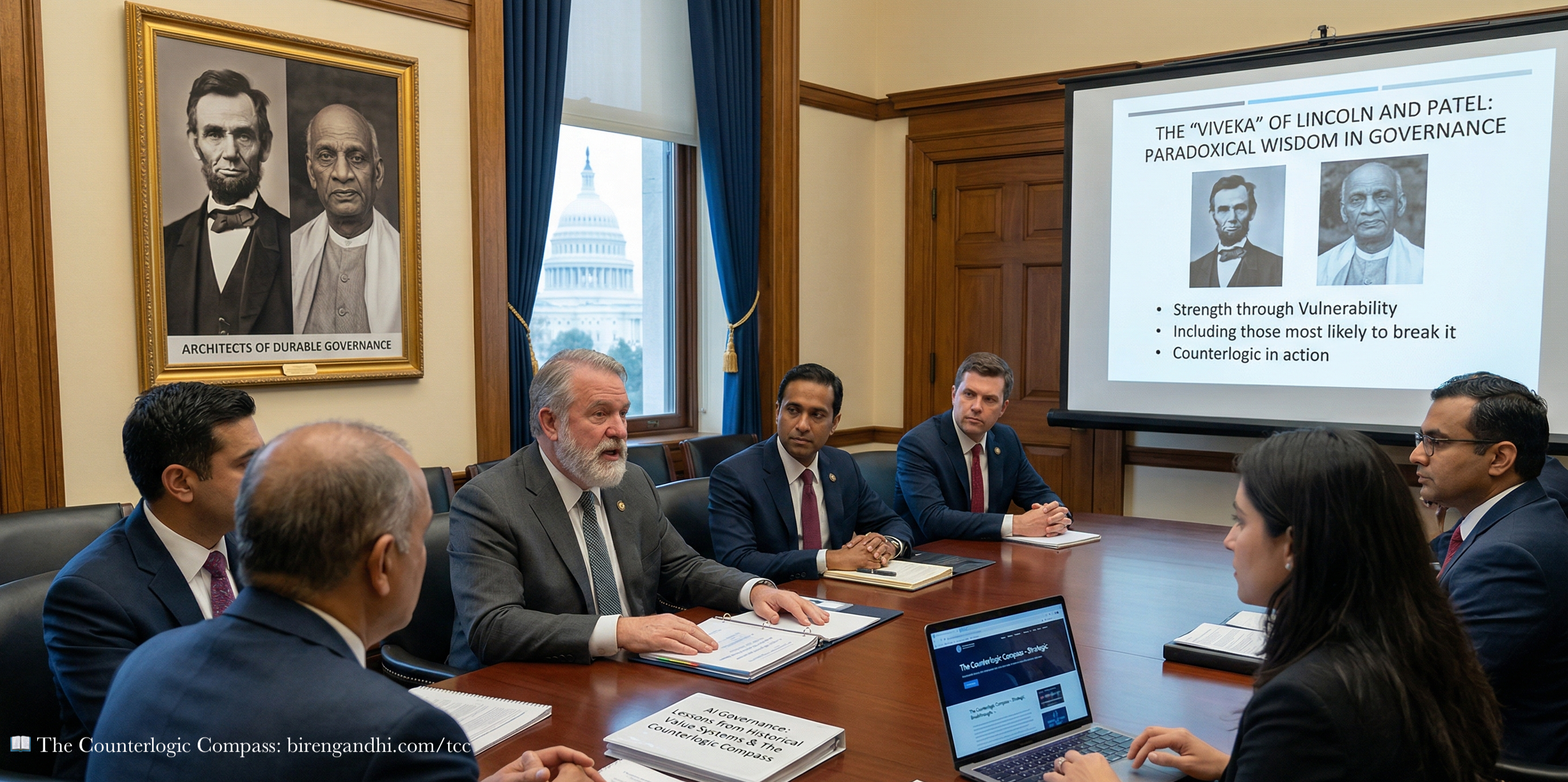
What Lincoln, Patel, and the history of great governance teach us about who actually belongs in the room when you design AI.
There is a counterintuitive insight woven through the history of every governance system that actually worked: the people who built it included the people most likely to break it.
This runs directly against instinct. When building something — a product, a policy, an AI system — the natural impulse is to surround yourself with people who believe in the mission. Critics slow things down. Skeptics raise obstacles. Opponents, by definition, oppose.
The Counterlogic Compass, which explores paradoxical wisdom as a framework for strategic breakthroughs, captures this precisely: contradictions like strength through vulnerability and creativity via constraints don't merely coexist with great outcomes — they produce them. The organizations that figured this out, from Toyota's production system to Google's structured dissent culture, didn't achieve durability despite friction. They achieved it because of friction — specifically, the friction of opposing intelligence forcing the design to account for its own weaknesses.
In AI governance, this insight is not a philosophical nicety. It is an architectural requirement.
Lincoln's Counterlogic
In May 1860, Abraham Lincoln walked into the Republican National Convention as the least credentialed candidate in the field. William H. Seward was the frontrunner — a celebrated New York senator with decades of national experience. Salmon P. Chase had been both governor and senator of Ohio. Edward Bates of Missouri was a revered elder statesman. Lincoln was a one-term congressman who had lost two Senate races.
Lincoln won the nomination. What he did next confounded observers even more: he appointed all three rivals to his cabinet. Seward became Secretary of State. Chase became Secretary of the Treasury. Bates became Attorney General. He later replaced Secretary of War Simon Cameron with Edwin Stanton — a man who had been openly contemptuous of Lincoln during the campaign and politically opposed to him at every turn.
Lincoln's reasoning was not sentimental. As historian Doris Kearns Goodwin documented in Team of Rivals, he believed these men were the strongest available for the roles that mattered most. Their opposition to him was irrelevant. The nation's survival was not. The question was never are they on my side? It was do they have what this problem demands?
The result was what Goodwin called the most unusual cabinet in American history — one that marshaled the full range of available intelligence precisely because it wasn't designed for agreement. It was designed for survival.
This is the counterlogic of governance: the strength of the system depends not on the alignment of its builders, but on the quality of their friction.
Patel's Paradox
A century later and a continent away, a parallel wisdom was at work during one of history's most complex governance challenges.
When Sardar Vallabhbhai Patel — India's Iron Man, independence fighter, and first Deputy Prime Minister — was tasked with integrating over 560 princely states into the new Indian Union, he needed a mind equal to the challenge. The man he chose was V.P. Menon.
The complexity was this: Menon had spent his career serving the British Viceroys — Linlithgow, Wavell, Mountbatten. He had been appointed Political Reforms Commissioner to the last Viceroy. He had, in fact, drafted the plan that formalized the partition of the subcontinent — the very partition that Patel and the Congress had spent decades opposing. By any conventional measure of political alignment, Menon represented the institutional opposite of everything Patel stood for.
Patel appointed him anyway.
As Secretary of the Ministry of States, Menon became the operational architect of India's unification — traveling across the subcontinent, negotiating with resistant princes, drafting the Instrument of Accession, and holding together a process that, under the conditions of communal violence and impossible timelines, might easily have collapsed. Historian Narayani Basu wrote that "no narrative of India's unification is complete without acknowledging the contributions of VP Menon." Patel's open contempt for the British imperial apparatus was precisely what could have blinded him to Menon's indispensable value. Instead, his clarity about the mission overrode his personal opposition.
What Patel understood — what made him great — is what the Counterlogic Compass calls losses as strategic gains: the willingness to absorb the apparent loss of ideological purity in exchange for the strategic gain of superior capability. Menon's intimate knowledge of the British legal and administrative framework wasn't a liability to be overlooked. It was the exact tool the mission required.
What This Has to Do with AI Governance
Most AI governance frameworks are built the way most organizations instinctively build things: by the people who are already in the room, who already believe in the mission, who are already optimized for capability and speed.
The critics are consulted after the fact — in external ethics reviews, in regulatory compliance processes, in post-deployment audits. They are treated as checkpoints, not collaborators. As filters, not architects.
This is the exact inversion of what Lincoln and Patel understood.
In our post on Governance-by-Design, we argued that governance embedded in architecture is structurally superior to governance bolted on as policy. The same principle applies to the teams that design the governance: critics embedded in the design process are structurally superior to critics consulted as reviewers. The difference is not cosmetic. It changes what gets built.
A civil liberties expert who distrusts surveillance systems will find failure modes that an AI team optimizing for accuracy will never think to look for. A clinician who has watched AI diagnostic tools fail real patients will architect safeguards that an engineer benchmarking against test datasets will not anticipate. A regulator who understands where accountability gaps appear in practice will write audit requirements that an internal compliance team — incentivized to minimize friction — will systematically underspecify.
These are not hypothetical contributions. They are the load-bearing walls of a trustworthy system. Leaving them out doesn't make the system faster to build. It makes the system more fragile at the moments that matter most.
The Viveka Principle — Discernment Over Comfort
The Vedic concept of Viveka — discriminative wisdom, the ability to distinguish between what is real and what is merely comfortable — is the cognitive capacity that Lincoln and Patel exercised when they made their counterintuitive appointments.
Most teams optimize for comfort. They build with people who share their assumptions, their vocabulary, their sense of what success looks like. This produces fast consensus, smooth working relationships, and governance frameworks that fail in exactly the ways that no one inside the room was positioned to predict.
Viveka demands something harder: the ability to recognize that the perspective you most resist may be the one your design most requires. That the voice that slows you down may be identifying a structural weakness, not an obstacle. That the critic is not an adversary — they are an unpaid stress-tester whose feedback, if incorporated early, costs far less than the failure it prevents.
Applied to AI governance team design, Viveka produces a different question than the one most organizations ask. Instead of who believes in this system?, it asks: who understands, in structural detail, how this system could fail — and is motivated to prevent that failure rather than suppress it?
The Counterlogic AI Governance Audit
When assembling the team that will design, review, or stress-test your AI governance framework, apply these questions:
The Rival Test: Does our governance team include people who have actively opposed similar systems in the past — not as adversaries, but as collaborators? If everyone in the room believes the system is a good idea, the room is missing its most valuable members.
The Domain Boundary Test: Have we included people who understand the second and third-order consequences of this system in its actual deployment context — not just its technical specifications? The clinician. The regulator. The affected community representative.
The Patel Question: Is there anyone whose background or prior institutional role we have unconsciously disqualified — whose knowledge of the very system we're governing is precisely what makes them indispensable?
The Friction Audit: At what points in our design process did we experience the least disagreement? Those are the most dangerous sections of the design. Smooth consensus in governance design usually means a blind spot, not a strong point.
The Stanton Standard: Are there people whose criticism of our current approach is the sharpest — and have we seriously considered whether their criticism identifies a structural flaw rather than an obstacle to progress?
The Post-Deployment Question: Who will be most affected by failures in this system? Have they had meaningful input into its design — not in a focus group, but in the architectural decisions?
Conclusion: The Paradox That Builds
The Counterlogic Compass argues that mastering paradox — not avoiding it — is the source of competitive advantage. Nowhere is this more true than in governance design.
The instinct to build AI governance with believers is understandable. It is also the instinct that produces systems with predictable blind spots, accountability vacuums, and failure modes that only emerge at scale — when the cost of correction is highest and the credibility damage is hardest to contain.
Lincoln didn't build the strongest cabinet in American history despite including his most formidable opponents. He built it because of them. Patel didn't unify India despite working with a man who had served the colonial system. He accomplished it through him.
The people most likely to challenge your AI governance design are not the people who will weaken it. They are the people who will make it hold.
Build accordingly.
The Counterlogic Compass is available at birengandhi.com/tcc. If you're designing AI governance frameworks and want to think through who should be in the room — and what a structurally rigorous review process looks like — FI Labs can help you build systems designed to survive contact with the real world.